
A flat white and a latte are both espresso with steamed milk. A flat white is smaller, with less milk and a thinner layer of silky foam, so it tastes much more of coffee. A typical flat white is 5 to 6 ounces. A latte starts at about 8 ounces and often goes to 16. Both usually use a double shot, so the latte spreads the same coffee through two or three times as much milk.
Choose a flat white if you want to taste the coffee with a creamy texture. Choose a latte if you want a bigger, milder, sweeter drink. They carry the same caffeine when they are made with the same shots.
Side by side
| Flat white | Latte | |
|---|---|---|
| Typical size | 5–6 oz | 8–16 oz |
| Espresso | Double, often ristretto | Single or double |
| Milk at home | 100–120g | 150–200g for 8–10 oz, about 350g for 16 oz |
| Espresso to milk | About 1:4 | About 1:5 for 8–10 oz, about 1:10 for 16 oz |
| Foam | A very thin, velvety layer worked into the milk | A thin layer, about 1cm |
| Tastes | Coffee-forward, creamy, silky | Mild, sweet, milky |
| Caffeine | The same as a latte with the same shots | The same as a flat white with the same shots |
| Calories, whole milk | About 65 | About 105 for 8–10 oz, about 210 for 16 oz |
The espresso-to-milk figures compare the weight of espresso in the cup with the weight of milk. A flat white made with about 27g of ristretto and 110g of milk is roughly 1:4. A latte made with 36g of espresso and 175g of milk is about 1:5, and the same double shot in a 16-ounce latte is nearer 1:10.
Cafés vary, so treat these as typical rather than as rules. Some chains sell a flat white in the same cup sizes as a latte. There, the difference comes down to the shots and the texture of the milk, not the amount of it.
Which is stronger?
A flat white tastes stronger. A latte has the same caffeine. Those are different things.
Strength is how much coffee you taste in each sip. A flat white puts a double shot into a little over half the milk of a regular latte, and about a third of the milk of a large one, so the espresso comes through clearly. In a latte, especially a large one, the milk takes over and the coffee becomes a background flavor.
Caffeine comes only from the espresso, and milk adds none. A flat white and a 16-ounce latte made with the same double shot carry the same caffeine. If a café puts an extra shot in its large lattes, the large latte has more. Caffeine in coffee has the numbers for a shot.
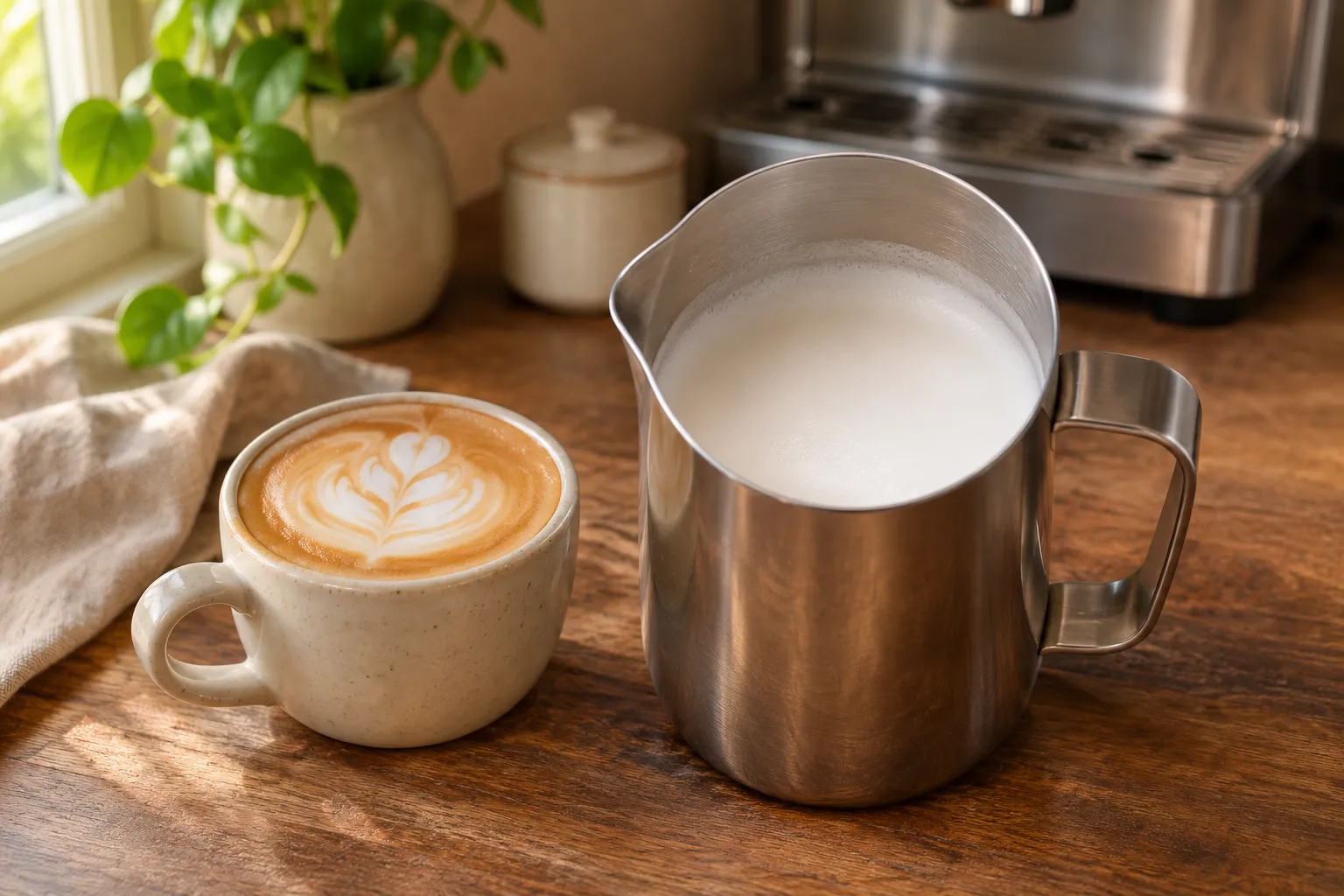
Smooth microfoam gives a flat white its thin, silky surface.
The milk is the real difference
Both drinks use steamed milk with microfoam: tiny, even bubbles worked all the way through the milk, so it looks glossy and pours like heavy cream. The difference is how much air goes in.
- For a flat white, froth only briefly. You want the milk barely thicker than it started, with a thin, flat layer on top. That flat surface is usually said to be where the name comes from.
- For a latte, froth a little longer, for a soft layer of foam about 1cm deep on top of the milk.
Neither should have the thick, airy cap of a cappuccino. If your flat white has a dome of foam, the milk was frothed too long.
The texture is also why both drinks are good for latte art. Microfoam pours in a smooth stream and holds a pattern on the surface. How to steam and froth milk covers the technique with a steam wand, an electric frother, a French press, or a jar.
The espresso: why flat whites often use ristretto
Many cafés make flat whites with a double ristretto: a shot stopped early, at about 1.5 times the weight of the coffee, rather than the usual 2 times. It is shorter, sweeter, and heavier, with less bitterness. In a drink this small, the coffee is front and center, so a sweeter shot makes a real difference. Espresso ratios explains how to pull one.
A latte usually uses a normal double shot. With so much milk, the extra sweetness of a ristretto is mostly lost.

Start with the espresso, then add the amount of textured milk your drink needs.
How to make each at home
| Flat white | Latte | |
|---|---|---|
| Espresso | Double ristretto: 18g in, about 27g out | Double shot: 18g in, 36g out |
| Milk | 100–120g | 150–200g |
| Froth | Briefly, for a thin glossy layer | A little longer, for about 1cm of foam |
| Cup | 5–6 oz | 8–10 oz |
- Pull the shot straight into the cup you will serve in.
- Heat and froth the milk to about 60–65°C (140–150°F): hot and steaming, but nowhere near a simmer.
- Tap and swirl the jug until the milk is glossy, with no large bubbles.
- Pour steadily into the middle of the espresso, lifting the jug as the cup fills.
How to make a latte at home walks through every step in more detail.
Without an espresso machine, a Moka Pot makes the better base for a flat white, because a small drink needs a strong, concentrated coffee. An AeroPress concentrate works well in a latte, where the milk is more forgiving.
Which should you choose?
| If you want… | Choose |
|---|---|
| To taste the coffee, with a creamy texture | Flat white |
| A big, mild, comforting drink | Latte |
| Fewer calories | Flat white |
| A flavored drink, such as vanilla or caramel | Latte; the syrup needs the extra milk |
| To show off a good bag of espresso beans | Flat white |
| The most for your money at a café | Usually a latte, at a similar price for more drink |
Want even more coffee and less milk? A cortado is about half espresso and half milk. A cappuccino is about the same size as a flat white but with a thick cap of airy foam. Latte vs cappuccino vs flat white compares all of them.
Common questions
Is a flat white just a small latte?
Close, but not quite. It has less milk and the same espresso, which makes it a smaller, stronger drink. The milk is also frothed less, so the foam is thinner and silkier, and the shots are often ristretto. A small latte made with a normal shot and a centimetre of foam tastes noticeably milder.
Does a flat white have more caffeine than a latte?
Only if it has more espresso in it. Most cafés use a double shot in a flat white. Some use a single shot in a small latte, in which case the flat white has about twice the caffeine. Ask how many shots go into each size.
Which has fewer calories?
The flat white, because nearly all the calories in either drink come from the milk. With whole milk, a flat white is about 65 calories, an 8- to 10-ounce latte about 105, and a 16-ounce latte about 210. Skim milk cuts each by about 40%.
Where does the flat white come from?
Australia and New Zealand, where both countries claim to have invented it in the 1980s. It spread through cafés in the UK and North America in the 2000s and 2010s.
Can you make a flat white with plant milk?
Yes. Use a “barista” version, which is made to foam. Oat barista milks come closest to dairy. Many ordinary cartons will not hold a foam at all, and a flat white has nowhere to hide thin, bubbly milk.