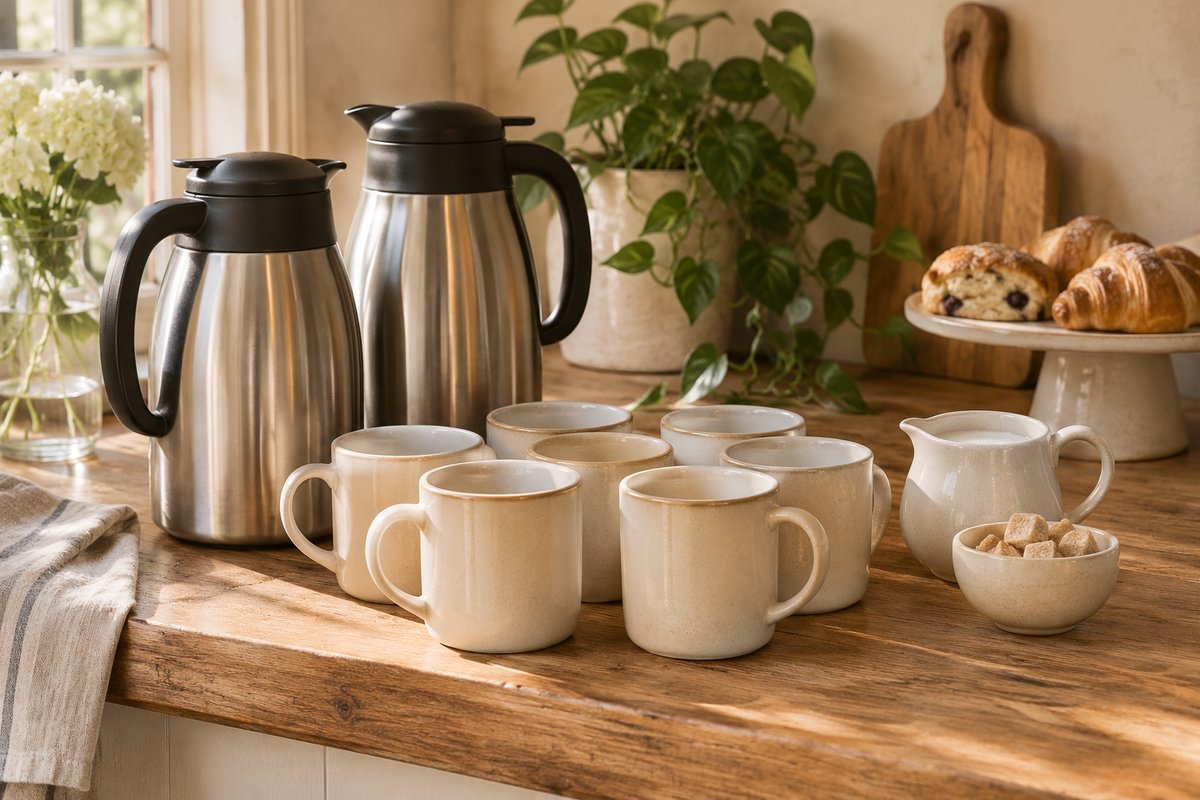
Coffee for every party size
These are the calculator's starting settings: 1½ cups per guest, 8-ounce cups, and the everyday 1:16 ratio. That is the right plan for a breakfast, brunch, or morning meeting. After dinner, when most people have one cup, use about two-thirds of each amount.
| People | Cups to pour | Coffee to pour | Ground coffee | 1 lb bags |
|---|---|---|---|---|
| 10 | 15 | 0.9 gallons | 254g (0.6 lb) | 1 |
| 20 | 30 | 1.9 gallons | 508g (1.1 lb) | 2 |
| 25 | 38 | 2.4 gallons | 643g (1.4 lb) | 2 |
| 30 | 45 | 2.8 gallons | 762g (1.7 lb) | 2 |
| 40 | 60 | 3.8 gallons | 1,016g (2.2 lb) | 3 |
| 50 | 75 | 4.7 gallons | 1,270g (2.8 lb) | 3 |
| 60 | 90 | 5.6 gallons | 1,524g (3.4 lb) | 4 |
| 75 | 113 | 7.1 gallons | 1,913g (4.2 lb) | 5 |
| 100 | 150 | 9.4 gallons | 2,539g (5.6 lb) | 6 |
"Coffee to pour" is finished coffee in the pot. You brew with a little more water than that, because the grounds hold some back; the calculator shows the water to put in.
How the amounts are worked out
Cups first. The number of people times the cups each one drinks gives the cups to pour, rounded up so nobody misses out. The occasions use the rules of thumb in how much coffee for a crowd: 1½ cups each in the morning, 1 after dinner, and 2 for a crowd that loves its coffee. Change the number if you know your guests.
Then the ratio. Standard strength is 1:16, the same ratio the drip and French press recipes start from: 1g of coffee for every 16g of water. Stronger is 1:15 and lighter is 1:17.
Then what the grounds keep. Wet coffee grounds hold on to about twice their weight in water, so a pot never pours all the water you put in. The calculator adds that back, which is why an 8-ounce cup works out to about 17g of coffee here rather than the 15g in how much coffee per cup. That page counts the water going in; this one counts the coffee coming out, which is what matters when you are filling cups.
Measuring a big batch without a scale
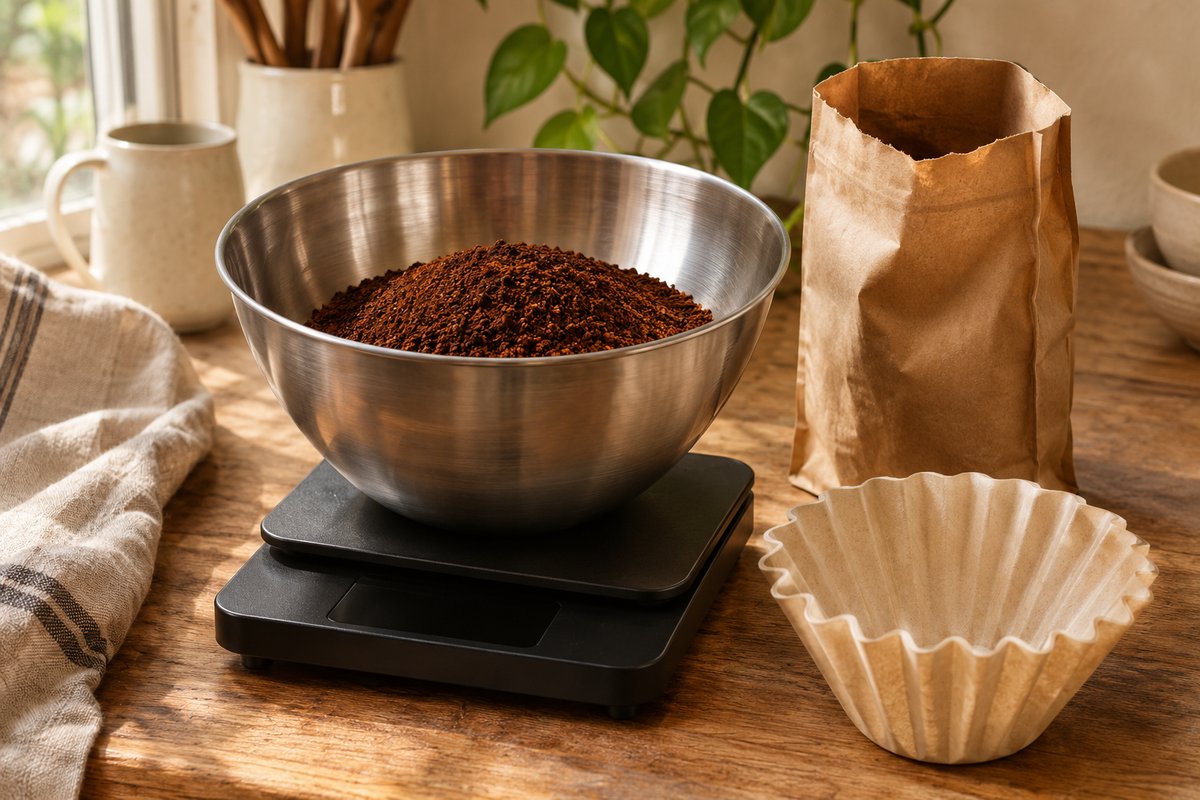
A level tablespoon of ground coffee is about 5g, and a measuring cup of grounds is about 80g. The calculator gives tablespoons for small batches and cups of grounds for big ones, because counting out 100 tablespoons is how mistakes happen. Spoons drift with grind and roast, so for anything over a pound of coffee, a kitchen scale is worth borrowing. Why spoons are only approximate explains the difference.
Brewing it
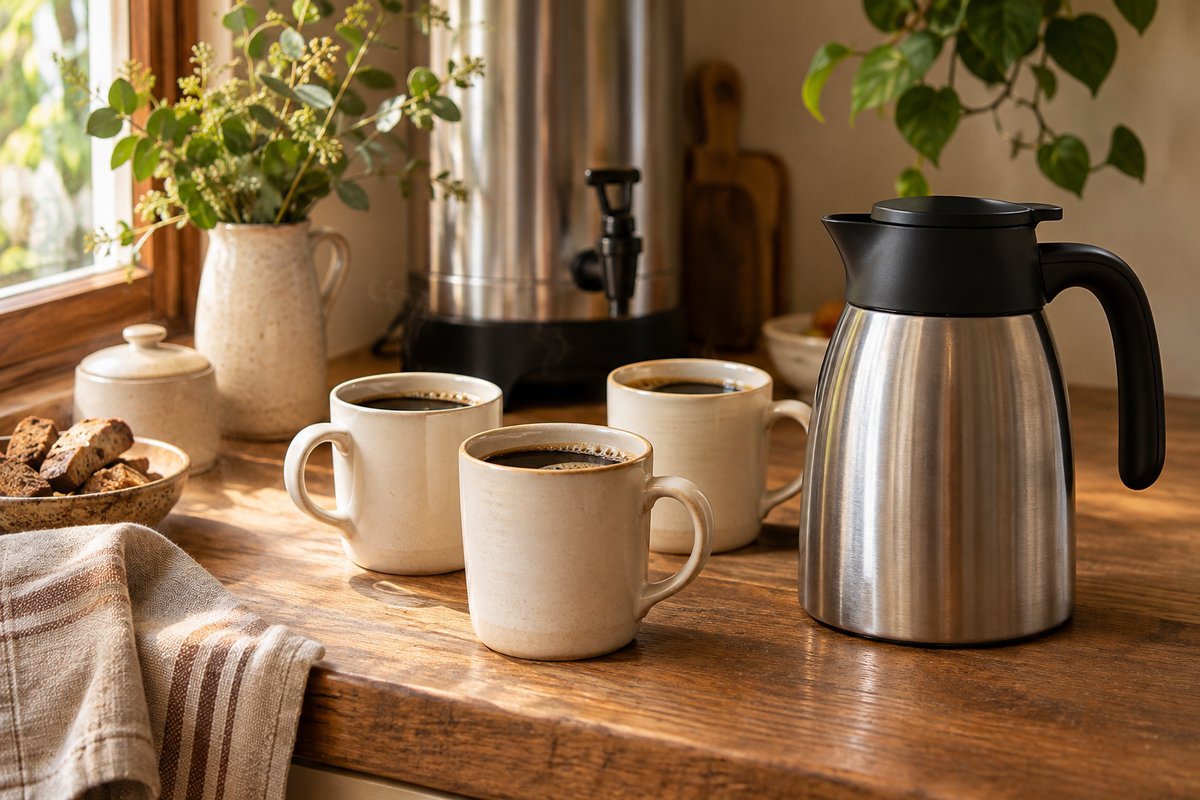
- Up to about 30 people: a drip machine, brewing pot after pot into thermal carafes. The calculator tells you how many full 12-cup pots that is.
- 50 people or more: an urn. Urns cycle water through the grounds many times and need less coffee per cup, so use the chart in the urn's manual rather than these amounts.
- Grind a step coarser for a full basket. A deep bed of coffee brews stronger and more bitter at the same grind; a full basket brews stronger explains why.
- Move it off the warming plate. Coffee left on heat tastes stewed within about half an hour. See keeping a big batch hot.
For one pot at a time, the coffee ratio calculator scales a drip recipe to the water your machine holds. To see what the whole event costs, put your bag price into the coffee cost calculator.