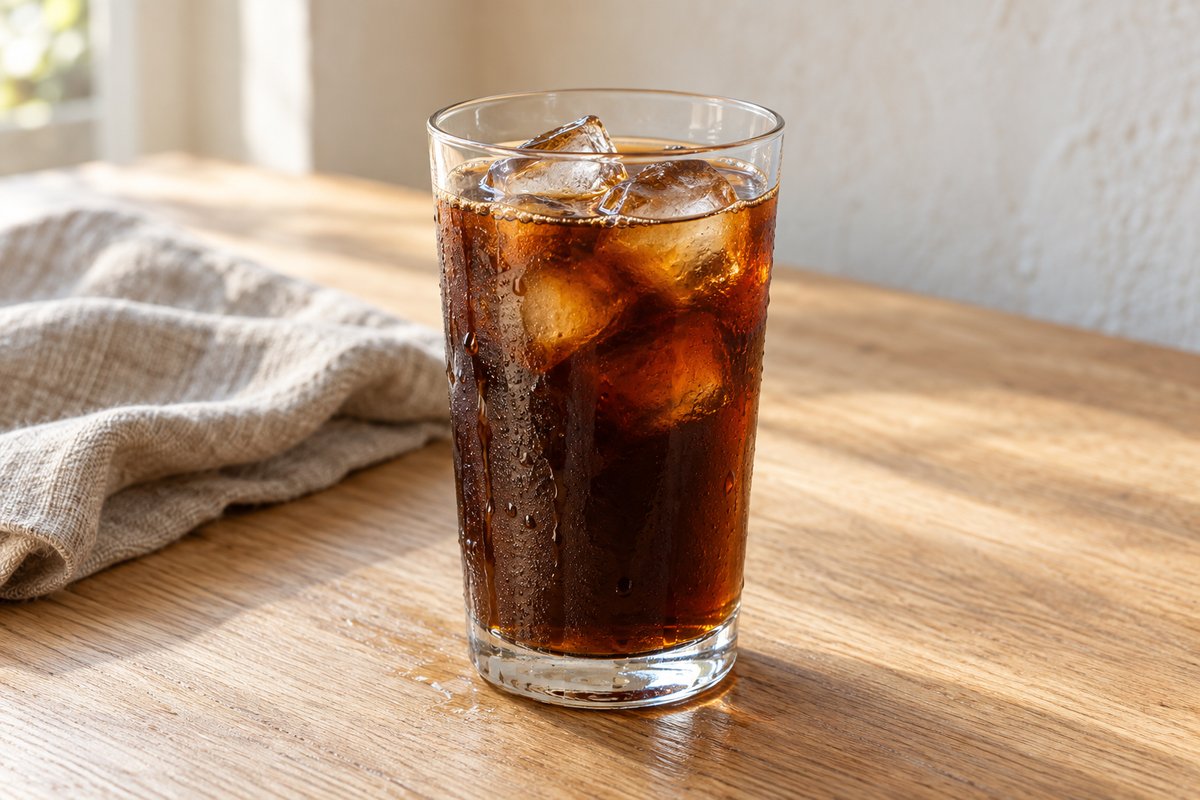
To make iced coffee that does not taste watery, brew hot coffee straight onto ice, with about a third of your usual water replaced by ice in the carafe. For one large glass: 30g of coffee, 320g of hot water through the grounds, and 160g of ice waiting underneath. The ice melts as the coffee lands, so the finished drink is chilled in seconds and comes out at your normal strength.
This is often called flash brew, or Japanese-style iced coffee. It takes as long as a normal cup, and it keeps the bright, fruity flavours that cold brew smooths away. If you want cold coffee now, rather than tomorrow, this is the way to make it.
Why not just pour coffee over ice?
Because the ice melts into it. A full glass of ice can add 100g of water or more as it cools hot coffee, which turns a well-made cup into a thin one. The flash brew method plans for that melt: the ice in the carafe is part of the brewing water, so when it has melted, the ratio is exactly what you meant.
Chilling a pot of leftover hot coffee in the fridge avoids the dilution, but it is slow, and coffee that cools slowly loses aroma and tends to taste flat and papery. Cooling it instantly on ice keeps more of what made it taste good hot.
Start with this recipe
This uses a pourover cone, but the same idea works in every brewer below. Makes about 14 ounces before serving ice.
- Put 160g of ice in your carafe or a heatproof jug, and set the cone on top.
- Add 30g of coffee, ground a step finer than you would for hot pourover.
- Pour 320g of water just off the boil, in the same pattern as the pourover recipe: a bloom first, then slow pours.
- When it has drained, swirl the carafe until the last of the ice melts.
- Pour over a glass of fresh ice and drink it while it is cold.
Why grind finer? With a third of the water held back as ice, less hot water passes through the coffee. A slightly finer grind lets that smaller pour extract as much as a full one would. Use hot water too: just off the boil, rather than letting the kettle sit, for the same reason.
The ice in the glass will still melt a little. Coffee ice cubes, made from yesterday’s leftovers in an ice tray, chill without diluting at all.
How to split the water
Work out the total water you would use for a hot cup, then put a third of it in the carafe as ice and pour the other two thirds hot. The ratio calculator gives you the total for any amount of coffee.
| Coffee | Total water | Hot water | Ice in carafe | Makes |
|---|---|---|---|---|
| 20g | 320g | 215g | 105g | About 9½ oz |
| 30g | 480g | 320g | 160g | About 14 oz |
| 45g | 720g | 480g | 240g | About 21 oz |
These are all the site’s usual 1:16. For a stronger drink, which stands up better to milk, try 1:14 or 1:15 and split it the same way. Ice cubes vary in size, so weigh the ice if you can. If you cannot, a generous cup of ice cubes is close to 160g.
You can push the ice up to about 40% of the total if you like it very cold. Go much past that and there is not enough hot water left to extract the coffee properly.
Iced coffee in other brewers
AeroPress. Put 60g of ice in your cup. Brew 15g of coffee with 120g of hot water, a step finer than usual, and press straight onto the ice. That is the AeroPress baseline 1:12, with a third of the water as ice.
French press. Brew 30g of coffee with 320g of hot water as usual, then pour it over 160g of ice in a jug instead of into a mug. Grind a little finer than normal, or let it steep a minute longer. Do not put ice in the press itself: it cools the brew before it has finished extracting.
Drip machine. Use your normal amount of coffee with two thirds of the water in the reservoir. Put the rest, as ice, in a heatproof jug, and pour the coffee onto it as soon as the machine finishes. Most glass carafes are not made for ice, so check your manual before putting ice in one, and never leave ice in a carafe on a warming plate.
Espresso. For an iced latte, pull the shot over a few cubes, then add cold milk and more ice. How to make a latte covers the ratios of coffee to milk.
Iced coffee or cold brew?
Same glass, different drinks. Choose by taste and by when you want it.
| Iced coffee (flash brew) | Cold brew | |
|---|---|---|
| Time | About 5 minutes | 12 to 24 hours |
| Taste | Bright, fruity, closer to hot coffee | Smooth, sweet, low acidity |
| Coffee per glass | About the same as a hot cup | Nearly double |
| Keeps | Drink it fresh | A week or more as concentrate |
| Best beans | Light and medium roasts | Medium and dark roasts |
Flash brew is the better way to taste a light, fruity coffee cold: cold brewing flattens exactly the flavours you paid for. Cold brew wins when you want a week of iced coffee from one batch. See the cold brew ratio for how much coffee that takes.
Caffeine follows the coffee, not the temperature. A glass of cold brew usually has more than a glass of flash brew because it is made with so much more coffee; see which coffee has the most caffeine.
Sweetening iced coffee
Sugar barely dissolves in cold coffee and sinks to the bottom. Two easy fixes:
- Stir it into the hot coffee in the carafe, before it hits the serving ice.
- Make simple syrup: equal weights of sugar and hot water, stirred until clear. It keeps in the fridge for a few weeks and mixes into cold drinks instantly.
Fix the cup
| What you notice | Likely cause | First change |
|---|---|---|
| Watery or thin | Too much ice melt, or too little coffee | Swap water for carafe ice, or try 1:14 |
| Sour or sharp | Under-extracted from the smaller pour | Grind finer, and use water just off the boil |
| Bitter or harsh | Ground too fine | Grind a step coarser |
| Flat, no aroma | Stale beans, or coffee chilled slowly | Check the roast date; brew onto ice, not into the fridge |
| Not cold enough | Too little ice in the carafe | Raise the ice toward 40% of the water |
Most of these are the same fixes as hot coffee, because it is hot coffee until it lands. Fix sour, bitter, or weak coffee covers each one in more detail.