Baseline recipe
- Coffee
- 60 g
- Water
- 600 g
- Grind
- Coarse (sea salt)
- Temperature
- Cool or room-temperature water
- Time
- 12–16 hours
- Ratio
- 1:5 – 1:12
How strong do you like it?
Balanced — 60 g coffee to 600 g water, about 1:10.
Fine-tune the flavor
What do you want to taste?
The recipe as written.
How should it feel?
The recipe as written.
Scale this recipe or diagnose the next cup with the Brew Compass.
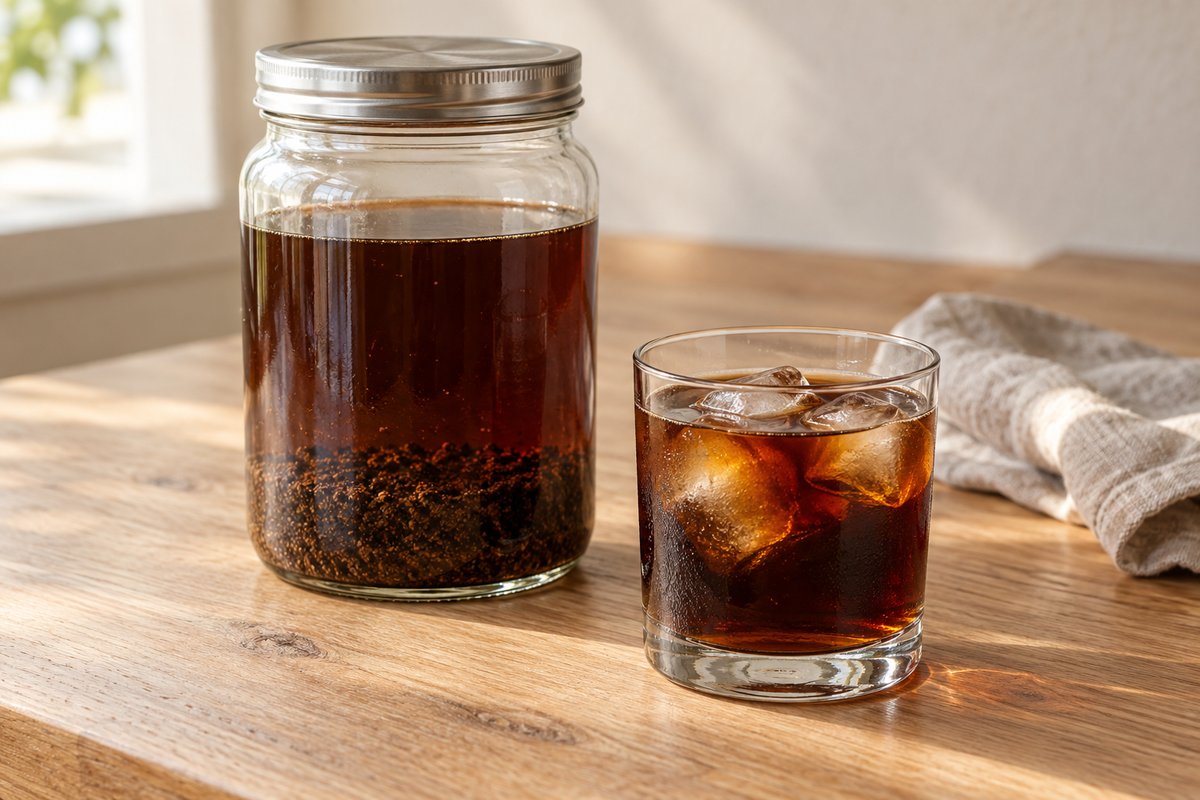
Cold brew is the least demanding method on this site. Because the water never gets hot, it pulls out less of the acidity that makes hot coffee taste bright and sharp, and less of the harsh bitterness that comes from over-extraction. What you get instead is sweet, heavy, and mellow — and it takes about four minutes of actual work spread across a day. If hot coffee bothers your stomach, see low-acid coffee for what cold brew does and does not change.
Start with this recipe
This makes about 480g, or 16 ounces, of ready-to-drink cold brew.
- Combine 60g coarse-ground coffee with 600g cool water in a jar or brewer.
- Stir until no dry pockets remain. Dry clumps float and never extract.
- Cover and steep 12–16 hours at room temperature, or 18–24 hours in the fridge.
- Strain through a fine mesh sieve, then through a paper filter if you want it cleaner.
- Serve over ice.
Steeping on the counter extracts faster than steeping in the fridge, so if you refrigerate, push toward the longer end of the range.
Ready-to-drink or concentrate
This is the decision that confuses most people, and it is just a choice of ratio.
| You want | Ratio | For 600g water | Serve |
|---|---|---|---|
| Ready to drink | 1:10 – 1:12 | 50–60g coffee | Straight over ice |
| Concentrate | 1:5 – 1:8 | 75–120g coffee | Diluted 1:1 with water or milk |
The strength buttons in the recipe box at the top of this page move along exactly this table: Gentle and Balanced land in the ready-to-drink band, Strong and Extra strong land in the concentrate band.
Concentrate is the more practical choice if you drink cold brew regularly. It takes up less fridge space, keeps slightly better, and lets you decide the strength in the glass rather than at brew time. Dilute it 1:1 to start, then adjust. Diluting matters for more than taste: poured straight, concentrate carries two to three times the coffee of a mug of drip, and the caffeine to match — see which coffee has the most caffeine. The cold brew ratio guide shows how strong each ratio ends up in the glass, and how much coffee fits in a pint or quart jar.
Remember that ice dilutes too. A glass filled with ice can add 50–100g of water as it melts, which is enough to make a well-judged ready-to-drink batch taste thin by the bottom of the glass. Brewing slightly strong and pouring over ice is the fix.
Making a bigger batch
Keep the ratio and scale everything together. Coffee for a ready-to-drink batch at 1:10, or a concentrate at 1:5:
| Water | To drink | Concentrate |
|---|---|---|
| 600g | 60g | 120g |
| 1 liter | 100g | 200g |
| 2 liters | 200g | 400g |
The grounds hold on to about twice their weight in water, so a concentrate gives back much less than you put in: 1 liter of water with 200g of coffee makes about 600g of concentrate. A large batch also takes longer to strain, so leave time for it.
Grind and steep time
Coarse, like sea salt. Cold brew’s long steep makes fine grounds a liability: they over-extract into harshness and turn straining into a slow, silty mess.
- Too fine — muddy, woody, hard to filter, bitter despite the cold water.
- Too coarse — flat and weak even after a full steep.
Steep time is a gentler dial than grind. Between 12 and 16 hours at room temperature, most of the difference is strength rather than quality. Push much beyond that — or past about 24 hours in the fridge, where extraction runs slower — and coffee starts picking up woody, papery flavors that no dilution will fix.
Filtering
Straining well is what separates good cold brew from gritty cold brew.
- First pass: a fine mesh sieve, or lift out the brewer’s basket. Let it drain on its own — do not squeeze or press the grounds, which forces bitter fines through.
- Second pass (optional): a paper filter, a cloth, or a paper-lined sieve. Slow, but it removes the silt that makes cold brew taste heavy on the tongue.
If you are using a French press as a cold brew vessel, plunge gently and decant everything immediately. Coffee left sitting on the grounds keeps extracting even cold.
Storage and freshness
Keep finished cold brew refrigerated in a clean, sealed container.
- Undiluted concentrate: best within about 7–10 days.
- Ready-to-drink or diluted: best within 2–3 days, since it is mostly water.
It rarely spoils dramatically; it fades. Aroma goes first, then sweetness, leaving something flat and cardboard-like. Make batches you can finish rather than brewing a large jar you will still be working through next week.
Adding milk shortens that window considerably — mix it by the glass, not by the jar.
Fix the cup
| What you notice | Likely cause | First change |
|---|---|---|
| Weak or watery | Ratio too high, or ice melt | Use more coffee, or brew a concentrate |
| Harsh, woody, drying | Steeped too long, or ground too fine | Shorten the steep; grind coarser |
| Silty or heavy on the tongue | Fines got through | Add a paper filter pass; do not squeeze the grounds |
| Sour | Under-extracted, unusual for cold brew | Steep longer, or grind a step finer |
| Flat and dull | Stale batch, or stale beans | Brew smaller batches; check the roast date |
The Brew Compass turns any of these into one change for the next batch.
Cold brew is not iced coffee
Two different drinks, often confused on menus:
- Cold brew is brewed cold from the start. Smooth, sweet, low-acid, and slow.
- Iced coffee is brewed hot and then chilled. It keeps the brightness and acidity that cold brewing leaves behind.
If you want cold coffee that still tastes fruity and sharp, you want the second one — brew pourover directly onto ice, replacing about a third of the water with the ice in the carafe so it does not end up watery. How to make iced coffee has the recipe for every brewer. If you want smooth and chocolatey, cold brew is the right tool.
For more on why the same beans taste different depending on temperature and method, see flavor profiles.