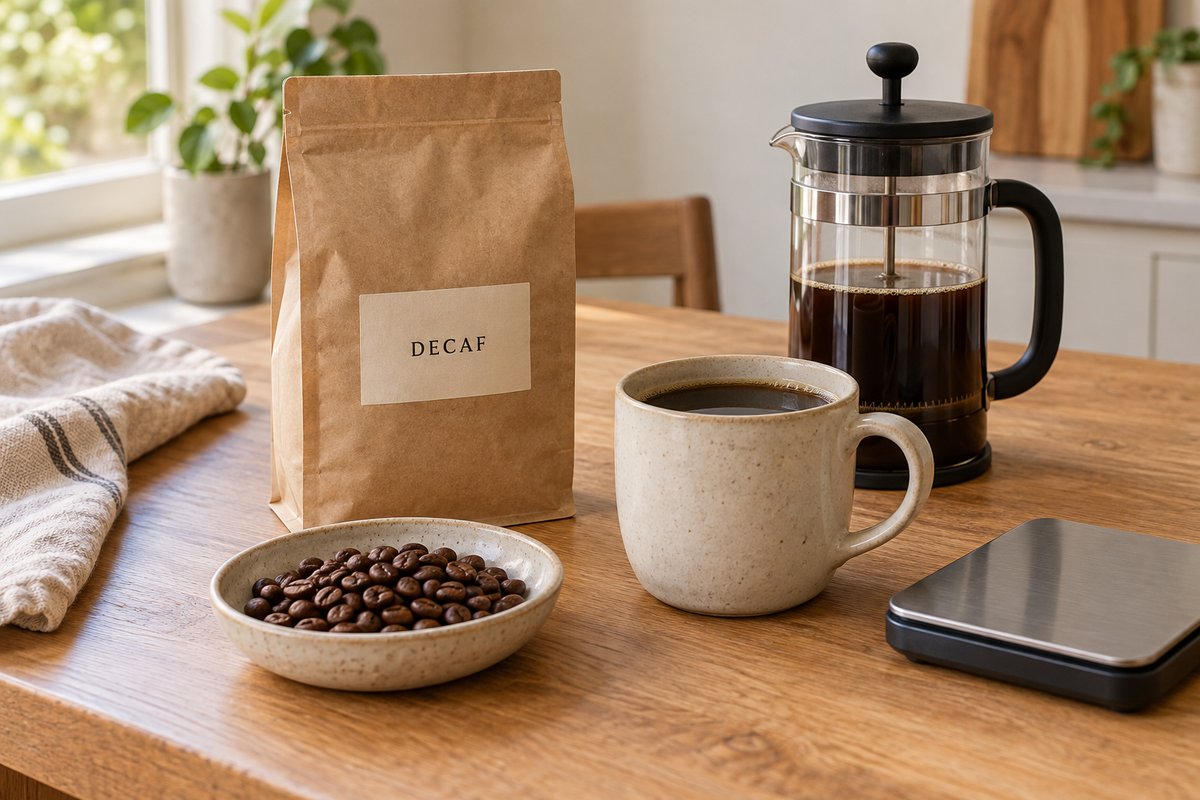
Yes. Decaf coffee usually contains about 2–15mg of caffeine in an 8-ounce / 240ml cup. That is the FDA’s published range, compared with about 96mg for the same size of regular brewed coffee in the site’s caffeine guide. Decaf means much less caffeine, not none.
For a good everyday bag, start with a fresh medium roast at a flavor profile you enjoy. If avoiding methylene chloride matters to you, choose a bag that specifically names a water, CO2, or sugarcane process. You can brew any of them with the recipes on this site.
How much caffeine is in decaf coffee?
The serving size matters as much as the word “decaf.” An espresso shot and a large café coffee are different drinks, and a milk drink may contain more than one shot.
| Drink | Serving | Caffeine |
|---|---|---|
| Regular brewed coffee | 8 oz / 240ml | About 96mg |
| Decaf brewed coffee | 8 oz / 240ml | Usually 2–15mg |
| Regular espresso | 1 oz / 30ml | About 63mg |
| Decaf espresso | One shot in a café study | About 3–16mg |
The regular-coffee figures are Mayo Clinic’s reference amounts and match which coffee has the most caffeine. The decaf brewed range is the FDA’s. The espresso range comes from McCusker and colleagues’ 2006 study: six decaf espresso samples from one Starbucks outlet contained 3.0–15.8mg per shot. It is evidence of variation, not a guaranteed range for every café or a modern double-shot recipe.
In that same study, decaf brewed samples from different outlets ranged from 0 to 13.9mg per 16-ounce serving. Do not confuse those measured servings with the FDA’s 8-ounce reference range, or assume the study predicts the bag you are brewing today.
Several cups still add up. Three 8-ounce cups at 15mg each would total 45mg; a decaf latte made with two shots also includes whatever caffeine is in both shots. Those are examples, not lab measurements of your drink. If you need a specific caffeine limit, ask the producer for tested figures and discuss suitable drinks with your clinician.
Why do caffeine percentages not tell you the amount in a cup?
Decaffeination removes most of the caffeine from green, unroasted coffee before roasting. A percentage describing caffeine removal or the remaining caffeine in beans is not a measurement of a brewed drink. The dose, serving size, and extraction still matter.
For example, Swiss Water describes its processed green beans as “99.9% caffeine-free,” but also explains that the caffeine in your final cup varies. That claim should not be read as a promise of zero milligrams in your mug.
Do not choose decaf by how dark, bitter, or strong it tastes. Strong flavor is not a caffeine measurement, and a naturally lower-caffeine species such as arabica is still regular coffee unless it has been decaffeinated. Arabica vs robusta explains the species difference.
How is decaf coffee made?
The beans are hydrated so caffeine can move out, processed to remove most of it, then dried and roasted. The four common approaches differ in what carries the caffeine away.
| Process on the bag | How it works | What the label tells you |
|---|---|---|
| Water process, including Swiss Water | Water with dissolved coffee compounds draws out caffeine; activated carbon filters remove caffeine from the circulating liquid | No methylene chloride or ethyl acetate is used in the named water process |
| CO2 / carbon dioxide | Pressurized carbon dioxide extracts caffeine from hydrated beans | Uses carbon dioxide rather than methylene chloride or ethyl acetate |
| EA / ethyl acetate, often called sugarcane | Ethyl acetate extracts caffeine; the beans are then steamed and dried | A solvent process; “sugarcane” describes its source, not sugar added to your coffee |
| MC / DCM / methylene chloride | Methylene chloride extracts caffeine; subsequent processing removes the solvent | A solvent process with regulated residue limits |
Swiss Water and Coffein Compagnie’s process descriptions explain the water and solvent methods; CR3 describes its carbon-dioxide process. Water and CO2 also act as solvents in the chemistry sense, so “chemical-free” is an imprecise label. The useful question is which process was used?
Ethyl acetate can come from fermentation-derived materials or be made synthetically. “EA” alone does not establish that it came from sugarcane. A specifically named sugarcane process is more informative. None of these process names guarantees a particular flavor, freshness, or exact caffeine level in your cup.
What about methylene chloride in decaf?
The current U.S. rule permits methylene chloride residue up to 10 parts per million in decaffeinated roasted coffee and instant coffee extract. That is the limit in 21 CFR 173.255, checked October 5, 2026. It is a limit for the coffee product, not a measurement of residue in every finished cup.
The FDA’s petition tracker, updated August 19, 2026, lists a petition seeking removal of this and other solvent authorizations as under review. A petition and an existing permission are different things; a request to change the rule is not an enacted ban.
The boiling point of a solvent does not prove that a particular bag contains none of it. That is why this guide does not give an unverified “usual” residue figure or promise that roasting removes every trace.
If you prefer to avoid this process, buy a bag explicitly labeled water-processed, CO2, or sugarcane/ethyl acetate. If the process is missing, ask the roaster. “Natural” on its own is not enough information to identify the method.
Does decaf taste different from regular coffee?
It can, but it still tastes like coffee. Decaffeination changes the green bean before the roaster gets it, and the original coffee, processing, roast, and freshness all shape the result. A watery or burnt cup is not something you have to accept because it is decaf.
Choose by flavor notes and roast level, then taste the bag. A medium roast is a useful first comparison if your usual decaf seems smoky. If you enjoy darker coffee with milk, a dark decaf may suit you better. A blend can be good too; single-origin is information about sourcing, not an automatic quality upgrade.
Coffee flavor profiles explains the label clues. Start with a small bag so you can try it while it is fresh, and store it like regular coffee in a sealed bag away from heat and light; coffee storage covers the details.
How should you brew decaf?
Keep the usual coffee-to-water ratio. Change the grind when the taste tells you to. You do not need extra grounds just because caffeine was removed, and your regular bag’s grinder setting is only a starting point for a new decaf.
For a straightforward first cup, use the site’s French press recipe: 20g coffee and 320g water, a 1:16 ratio. Start with a medium-coarse grind, like rough sand, and water around 200°F / 93°C. At four minutes, gently break the crust and skim the foam; let the grounds settle until nine minutes total. Lower the plunger just below the surface and pour. The method page gives the full sequence and scaling advice.
A pourover works just as well. Start with its baseline recipe rather than changing dose, temperature, and pouring all at once. Use the ratio calculator when you need a different batch size.
| What you taste | First change |
|---|---|
| Sour or sharp | Grind slightly finer; keep the dose and water weight steady |
| Bitter or drying | Grind slightly coarser; for a dark roast, try cooler water on a later brew |
| Balanced but weak | Use a little more coffee for the same water |
| Balanced but too strong | Add a little water to the finished cup |
| Flat or papery despite sensible adjustments | Check freshness before repeatedly changing the grind |
Coffee troubleshooting explains how to separate strength from extraction. For espresso, start with the site’s 18g in, 36g out baseline and dial in the new bag by taste and flow; dialing in espresso gives the sequence. Decaf is not a reason to chase a particular crema thickness or shot time.
Can you mix regular coffee and decaf?
Yes. For a half-caf batch, mix them 50/50 by weight, keeping the total dose the same. A 20g dose becomes 10g regular coffee and 10g decaf, with the same water weight.
This gives roughly half the caffeine of the regular coffee plus the small amount left in the decaf. It is not an exact 50% reduction. Similar roast levels make a useful first blend, though the grinder may need a small adjustment. To reduce further, increase the decaf share gradually instead of cutting brewing time short and making a sour cup.
Is decaf better for sleep or a sensitive stomach?
Decaf substantially reduces the caffeine you drink, which makes it a practical option when you want less of it. It does not guarantee that a late cup will suit your sleep, especially if you react strongly to small amounts of caffeine.
Decaf is not acid-free and does not promise relief from reflux or stomach pain. A same-size cup, made the same way, can be a useful comparison, but feeling better does not prove caffeine was the only cause: the bag and processing may differ too. Low-acid coffee covers taste acidity and other changes to consider.
If you have been told to avoid caffeine entirely, do not treat decaf as a caffeine-free substitute. Ask your clinician whether it fits that advice.
How do you choose a good decaf bag?
- Pick a roast and tasting notes you already enjoy. Medium roast is a sensible starting point, not a requirement.
- Check the roast date and buy a manageable amount. Whole beans keep better; buy smaller quantities if you need pre-ground coffee.
- Look for a named decaffeination process. Ask the roaster when the label leaves it out.
- Treat origin and process as clues, not quality rankings. A fresh blend can be a better fit for you than an expensive single-origin bag.
- Keep notes on one or two brews. Dose, water, grind, and what you changed will help you choose the next bag far more than the word “premium.”
The best starting point is a small, fresh bag and a recipe you already know. Give the grind a chance to settle before deciding decaf cannot taste as good as your regular cup.