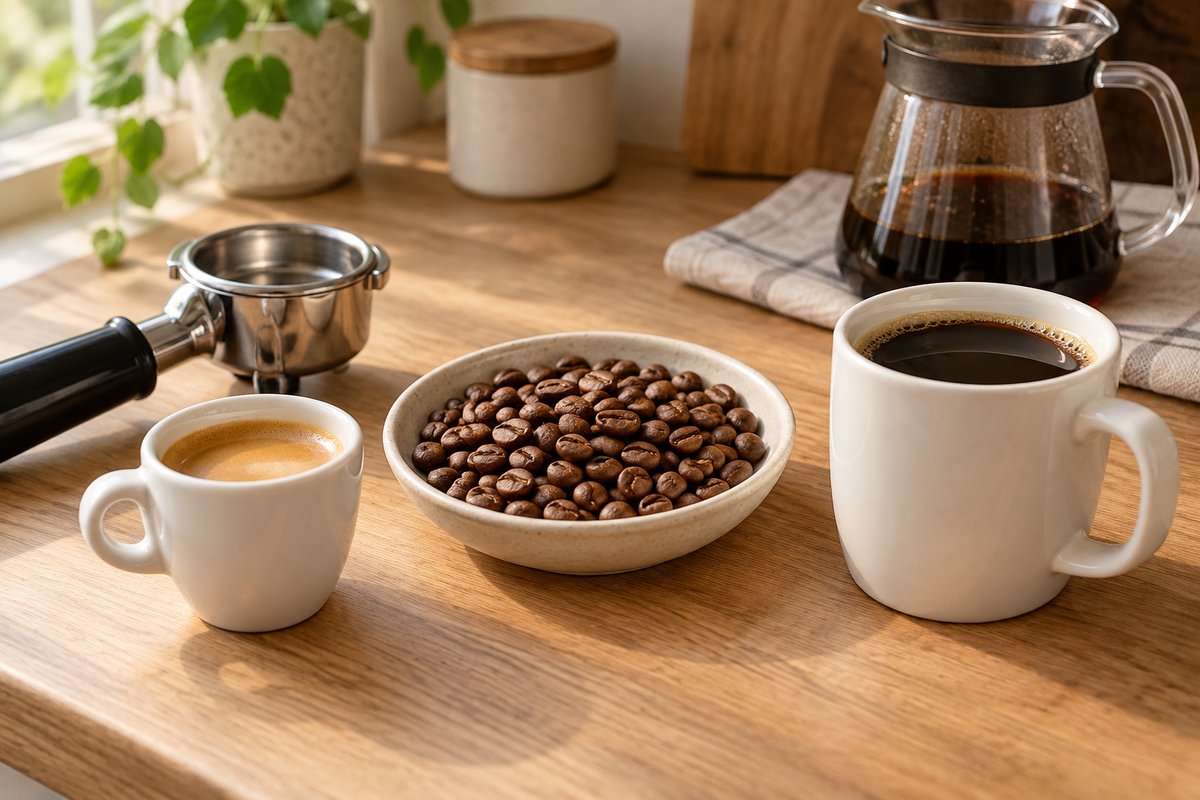
Espresso beans and coffee beans come from the same plants. “Espresso” on a bag describes how the roaster expects you to brew it, usually with a medium-dark to dark roast and a blend built to taste rich in a small, concentrated shot. Whole espresso beans brew good drip, French press, or cold brew, and many ordinary coffee beans make good espresso.
The label tells you about flavor, not about a different kind of bean. That makes the useful question “which flavor do I want in this cup?” rather than “am I allowed to use these?”
What the espresso label usually means
Roasters use the word in different ways, but a bag sold for espresso usually differs from a bag sold for filter coffee in three ways.
- A darker roast. Most espresso blends sit at medium-dark to dark. Roasting longer brings out chocolate, caramel, and toast, and tames the sharp acidity that a concentrated shot magnifies. It also makes the coffee easier to extract, so a shot is easier to get right. See light vs dark roast for what roasting changes.
- A blend. Espresso is often a mix of origins chosen so the shot tastes balanced and stays the same from bag to bag. A Brazilian base for body and nuttiness, with a coffee from Central America or Africa for sweetness or fruit, is a common pattern.
- Sometimes some robusta. Italian-style blends in particular often include robusta, which adds body, a thicker crema, bitterness, and caffeine. See arabica vs robusta.
None of this is a rule. Plenty of specialty roasters sell light, fruity single-origin coffees for espresso, and plenty of dark blends are sold for the drip machine.
Side by side
These are typical bags, not promises about every coffee.
| Espresso | Filter | |
|---|---|---|
| Roast | Medium-dark to dark | Light to medium |
| Usually | A blend, sometimes with robusta | A blend or a single origin |
| Tastes | Chocolate, caramel, nuts, toast | Fruit, flowers, brighter acidity |
| Body | Heavy, syrupy | Lighter, clearer |
| With milk | Stands up well | Fruit can get lost |
| Surface | Often a little shiny | Usually dry |
Can you brew regular coffee with espresso beans?
Yes. Whole espresso beans are just coffee, and you grind them for whatever brewer you use. Expect the cup to taste like a dark roast: chocolatey, heavy, and low in acidity, with a bitter edge if it is pushed.
Two things keep that edge in check:
- Use slightly cooler water, about 90°C (194°F), a minute or so off the boil. Dark roasts extract easily, so very hot water pulls out more bitterness.
- Go a step coarser than you would for a medium roast if the cup tastes harsh.
Espresso beans suit the French press, cold brew, the Moka Pot, and any coffee you drink with milk. They are a weaker fit for a V60 or other pourover if you want a bright, clear cup, because the roast has already traded that brightness for body.
Pre-ground espresso coffee is the exception. It is ground fine, like table salt, for an espresso machine. In a drip machine or a pourover it slows the water, clogs the filter, and tastes bitter. In a French press it slips through the mesh. Use it in a Moka Pot, where a fine grind is right, or in an espresso machine with a pressurized basket. For other brewers, buy whole beans or coffee ground for that brewer.
Can you make espresso with regular coffee beans?
Yes, with two conditions.
The beans need to be fresh. Espresso shows staleness more than any other method. Coffee roasted much more than a month ago tends to give a thin shot that runs fast, with little crema. Very fresh coffee causes trouble too: roasters often suggest resting beans for about a week before pulling shots. See coffee can also be too fresh.
The roast changes how hard it is. A medium roast makes a sweet, balanced shot without much fuss, and many filter coffees fall in that range. A light roast can make a remarkable shot, with fruit and sweetness a dark blend cannot match, but it is harder to extract. It needs hotter water and often a longer shot, and gets sour quickly if either falls short. See temperature and roast.
Which tastes better as espresso?
That depends on how you drink it.
| How you drink it | Look for |
|---|---|
| Lattes, cappuccinos, flat whites | A medium-dark espresso blend with chocolate or caramel notes |
| A straight shot, sweet and rich | A medium roast, blend or single origin |
| A straight shot, bright and fruity | A light or medium single origin, rested a week or more |
| A heavy, Italian-style shot with thick crema | A dark blend with some robusta |
| The same bag for espresso and filter | A medium roast, sometimes sold as an “omni roast” |
The tasting notes on the bag are a better guide than the word “espresso”. Chocolate, caramel, and nut words point to a shot that holds up in milk. Berry, citrus, and floral words point to a lighter roast that tastes best on its own. Coffee flavor profiles explains how to read them, and latte vs cappuccino vs flat white covers which drinks hide the coffee most.
Do espresso beans have more caffeine?
Not by the bean. Roast barely changes caffeine, and per gram a dark roast has slightly less, if anything. The real exception is robusta: a blend that contains it carries noticeably more caffeine than one that is all arabica.
Per cup, espresso usually has less. A single shot holds about 63mg of caffeine, against about 96mg in an 8-ounce cup of brewed coffee, because the shot uses less coffee. See which coffee has the most caffeine.
Reading the bag
- “Espresso roast,” “Italian roast,” “French roast”: dark, in roughly that order. Expect roast flavor over origin flavor.
- “Espresso blend”: a mix built for espresso. The bag may or may not say whether it contains robusta; if it does not mention the species, assume it might.
- “Single origin espresso”: one coffee, usually a lighter roast, best on its own.
- “Omni roast” or “filter and espresso”: a medium roast meant for both.
- Shiny, oily beans: a very dark roast. They fade faster, and they can gum up the grinder in a bean-to-cup machine, so some manufacturers advise against them. See storing and grinding each roast.
Whatever the label, check the roast date. Buy whole beans in a bag small enough to finish within a few weeks, and store them well.